Tuesday, 12 February 2019

Global Orthopedic Braces and Supports Market Rapidly Growing in Medical Industry

Factors such as growing prevalence of musculoskeletal disorders and diseases, rapid growth in the geriatric population, increasing sport participation across the globe (coupled with rising number of sports-related injuries), and growing market availability of orthopedic braces through e-commerce online sales and retail shops are driving the growth of the market.

The report studies the global orthopedic braces and supports market over the forecast period of 2017 to 2022. The market is projected to reach USD 4.93 Billion by 2022 from USD 3.76 Billion in 2017, at a CAGR of 5.6%.

Browse 74 Market Data Tables 
30 Figures 
331 Pages and in-depth TOC on "Orthopedic Braces and Supports Market"

The major players in the market are DJO Finance LLC (US), Breg, Inc. (US), Ossur Hf (Iceland), DeRoyal Industries, Inc. (US), Bauerfeind AG (Germany), Otto Bock Holding GmbH & Co. KG (Germany), BSN medical (Germany), medi GmbH & Co. KG (Germany), THUASNE Group (France), and 3M Company (US).

By Region, the market is segmented into North America, Europe, Asia Pacific, and the Rest of the World. North America is expected to account for the largest share of the market in 2017, followed by Europe. The market in North America is primarily driven by the continuous development and commercialization of novel orthopedic braces & support products and a significant level of medical reimbursements & insurance available for major orthopedic bracing procedures. 

However, Asia Pacific is expected to register the highest growth rate during the forecast period due to the rising geriatric and obese population (coupled with the significant prevalence of orthopedic & diabetes-related diseases in this population segment).

To Know More @ https://www.marketsandmarkets.com/Market-Reports/orthopedic-braces-support-market-24806829.html

Key Players in the Airway Management Devices Market

Smiths Medical (US),  Medtronic (Ireland)  & Teleflex (US) are the Key Players in the Airway Management Devices Market

The airway management devices market is consolidated in nature and the top three players dominated the market. In 2017, the global airway management devices market was dominated by Medtronic (Ireland), Smiths Medical (US), and Teleflex (US). Players implemented various strategies to expand their global footprint and share in the airway management devices market such as acquisitions and product launches.

The global airway management devices market is projected to reach USD 2.10 billion by 2023 from an estimated USD 1.60 billion in 2018 at a CAGR of 5.6%.

Smiths Medical (US) ranked second in the airway management devices market in 2017. In the field of airway management, the company offers devices such as endotracheal tubes and laryngeal masks with Soft-Seal cuffs and laryngoscopes. The company focuses on partnerships to strengthen its position in the market. With a diversified product portfolio, wide geographical reach, and focus on organic and inorganic strategies, the company has succeeded in creating a strong foothold in the airway management devices market

In 2017, Medtronic (Ireland) ranked first in the airway management devices market. In the field of airway management, the company offers an extensive range of airway management devices including laryngeal mask airways, endotracheal tubes, laryngoscopes, and stylets. Medtronic has a strong presence in the US, Puerto Rico, Brazil, Canada, Costa Rica, Denmark, the Dominican Republic, France, Germany, India, Israel, Italy, Japan, Malaysia, Mexico, the Netherlands, the People’s Republic of China, Singapore, South Korea, Switzerland, Thailand, Turkey, Vietnam, and the UK.

Monday, 11 February 2019

Endoscopy Equipment Market worth $34.82 Billion till 2022

Global endoscopy equipment market was valued at USD 24.32 Billion in 2016 and is projected to reach USD 34.82 Billion by 2022, at a CAGR of 6.4% during the forecast period.


The global endoscopy equipment market is projected to reach USD 34.82 Billion by 2022 from an estimated USD 25.58 Billion in 2017, at a CAGR of 6.4% during the forecast period. 

The growth of this market is majorly driven by factors such as favorable government initiatives, rising number of hospitals and growing hospital investments in endoscopy facilities, technological advancements, and rising prevalence of diseases that require endoscopy.

The endoscopy equipment market is segmented on the basis of product, application, end user, and region. On the basis of product, the global market is segmented into endoscopes, visualization equipment, other endoscopy equipment, and accessories. Endoscopes are expected to account for the largest share of the market in 2017 and this segment is also estimated to grow at the highest CAGR during the forecast period. 

Download FREE Brochurehttps://www.marketsandmarkets.com/pdfdownloadNew.asp?id=689

The dominant market share and growth rate of this segment can be primarily attributed to the rising adoption of minimally invasive procedures, increasing technological advancements, and disposable endoscopes and the subsequent need to repeat the purchase of these single-use products.

Based on application, the market is segmented into laparoscopy, gastrointestinal endoscopy, arthroscopy, obstetrics/gynecology endoscopy, urology, bronchoscopy, mediastinoscopy, otoscopy, laryngoscopy, and other applications. The GI endoscopy applications segment is expected to command the largest share of the market and grow at the highest CAGR during the forecast period. 

Rising geriatric population, improving healthcare infrastructure in developing countries, and increasing number of colonoscopy procedures performed in developed countries, are some factors supporting the growth of this applications segment.

Based on end user, the market is segmented into hospitals, ambulatory surgical centers (ASCs)/clinics, and other end users (diagnostic centers, mobile endoscopy facilities, and office endoscopy services). The hospitals segment is expected to register highest CAGR during the forecast period. This can be attributed to increasing government and private funding and the growing preference among physicians and patients to perform endoscopic procedures in a hospital-based environment.

To Know More @ https://www.marketsandmarkets.com/Market-Reports/endoscopy-devices-market-689.html

Thursday, 24 January 2019

Interventional Cardiology Products Market by Key Players & Region

The global interventional cardiology products market is expected to reach USD 20.85 Billion by 2022 from USD 14.52 Billion in 2017, at a CAGR of 7.5%. Market growth is primarily driven by the growing incidence of CVD and technological advancements in interventional cardiology devices.

The key players in the interventional cardiology products market  include Medtronic (US), Boston Scientific (US), Abbott Laboratories (US), Terumo (Japan), Cordis (US), B. Braun (Germany), C.R. Bard (US), Biosensors (Singapore), and BIOTRONIK (Germany).

Target Audience for this interventional cardiology products market 
  • Manufacturers and vendors of interventional cardiology devices
  • Research associations related to non-communicable diseases
  • Various research and consulting firms
  • Distributors of interventional cardiology devices
  • Contract research manufacturers of interventional cardiology devices
  • Healthcare institutions
  • Research institutes

The global  interventional cardiology products market  is dominated by North America, followed by Europe. North America will continue to dominate the global market in the forecast period. However, Asia Pacific is expected to witness the highest CAGR, with the growth in this market centered on Japan, China, and India. Factors such as the rising focus of major players in emerging Asia Pacific countries and government support are driving the growth of the interventional cardiology devices market in this region.

Tuesday, 22 January 2019

Clinical Workflow Solutions Market worth $12.1 billion by 2023 growing at a CAGR of 12.4%

The growth of this market is mainly driven by the increase in need to curtail healthcare costs and the increasing patient volume due to the rising prevalence of chronic diseases. Also, the advantages of clinical workflow solutions in enhancing patient care and safety along with the government initiatives for HCIT adoption are escalating the market growth.


"Clinical Workflow Solutions Market by Product (Data Integration, EMR Integration, Nurse Call Systems, Unified Communications, Care Solutions, Patient Flow Management, Enterprise Solutions), End Users, and Region - Global Forecast to 2023"


[208 Pages Report] The global clinical workflow solutions market is projected to reach USD 12.1 billion by 2023 from USD 6.8 billion in 2018, at a CAGR of 12.4%


North America is expected to account for the largest share of the clinical workflow solutions market in 2018, followed by Europe. The dominance of the North American region can be attributed to the growing healthcare IT spending, developed infrastructure, evolving regulations for better healthcare outcomes, and the presence of major market players in the region, need to cut healthcare costs and financial support from the government to enhance the quality of healthcare and improve the overall efficiency of healthcare organizations in the region and the presence of a large number of global players in this region.

The prominent players in the clinical workflow solutions market are are Hill-Rom Holdings, Inc. (US), Ascom Holding AG (Switzerland), GE Healthcare (US), Koninklijke Philips N.V. (Netherlands), Cisco Systems, Inc. (US), Stanley Black & Decker, Inc. (US), Cerner Corporation (US), Infor, Inc. (US), Allscripts Healthcare Solutions, Inc. (US), and McKesson Corporation (US).


Monday, 21 January 2019

Attractive Growth Opportunities in Parkinson's Disease Treatment Market

Parkinson’s disease treatment is used to treat the symptoms of Parkinson’s disease, generally, medication is the first line treatment for this disease.
 The global Parkinson’s disease treatment market is expected to reach USD 5.69 billion by 2022 from USD 4.24 billion in 2017, at a CAGR of 6.1%. Rising geriatric population and government funding for research on Parkinson’s disease are the driving factors for this market.

The Parkinson’s disease treatment market is segmented on the basis of drug class, distribution channel, patient care setting, and region. On the basis of drug class, the Parkinson’s disease treatment market is segmented into carbidopa/levodopa, dopamine receptor agonists, MAO-inhibitors, COMT-inhibitors, anticholinergics and other drugs. The carbidopa/levodopa segment is expected to account for the largest share of the market in 2017. The growth in this segment is primarily attributed to the potency of the drug.

By distribution channel, the Parkinson’s disease treatment market is segmented into hospital pharmacies, retailer pharmacies, and online pharmacies. In 2017, the hospital pharmacies segment accounted for the largest share of the market. Increasing number of patient visits to the hospital due to the availability of diagnostic laboratories and presence of skilled neurologists are driving the growth of hospital pharmacies segment.

On the basis of patient care setting, the Parkinson’s disease treatment market is segmented into hospitals and clinics. In 2017, hospitals are expected to account for the largest share of the Parkinson’s disease treatment market. Robust health infrastructure and presence of skilled neurologists are the driving factors for hospital segment.

Friday, 18 January 2019

Environmental Monitoring Market by Product, Region and Key Players - Forecast to 2021

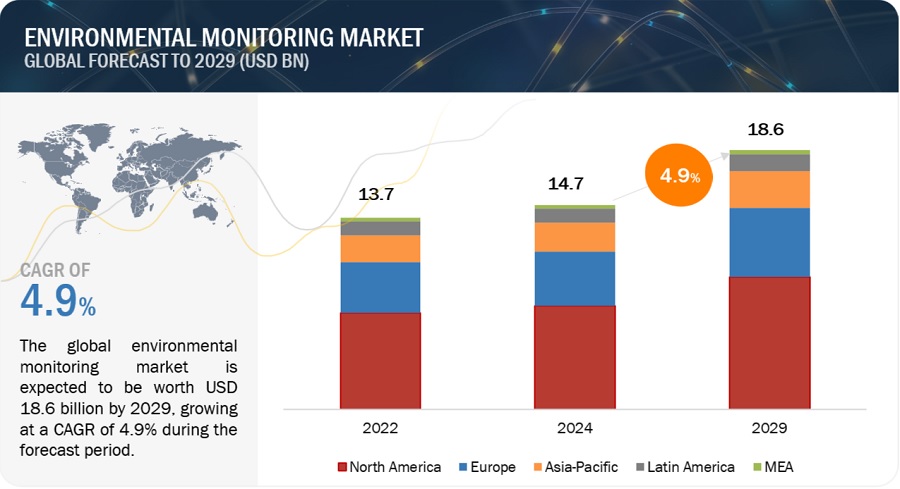
The global environmental monitoring market is expected to reach USD 19.56 Billion by 2021, growing at a CAGR of 7.7% during the forecast period. 
Factors such as increasing government initiatives to control environmental pollution levels, increasing government funding for pollution control and monitoring, ongoing installations of environment monitoring stations, and growing initiatives for the development of environment-friendly industries are driving the growth of the global market.
On the basis of product, the global environmental monitoring market is divided into three major categories, namely, environmental monitors, environmental sensors, and environmental monitoring software. 
The environmental monitor is further divided into two monitoring product segments, namely, fixed monitors and portable monitors. 
The environmental sensors segment is further divided on the basis of product architecture (analog sensors, and digital sensors) and on the basis of applications (temperature sensing, moisture detection, chemical detection, biological detection, particulate detection, and noise measurement). 
On the basis of region, this market is classified into North America, Europe, Asia-Pacific, and the Rest of the World. In 2016, the global environmental monitoring market is expected to be dominated by North America. Increasing government funding for the maintenance and operation of environmental monitoring stations and the stringent regulations of the U.S. ssEnvironmental Protection Agency (U.S. EPA) are driving the growth of the market in the North American region. 
The Asia-Pacific market is expected to grow at the highest CAGR during the forecast period. This is primarily due to rapid industrialization, implementation of increasingly stringent environmental regulation policies, and the growing need to comply with various environmental safety regulations.


As of 2015, Agilent Technologies, Inc. (U.S.), Danaher Corporation (U.S.), Honeywell International Inc. (U.S.), Siemens AG (Germany), Thermo Fisher Scientific Inc. (U.S.), TE Connectivity Ltd. (Switzerland), General Electric Company (U.S.), Emerson Electric Co. (U.S.), Teledyne Technologies Inc. (U.S.), and Merck KGaA (Germany)are some key players operating in the global market

To Know More @ https://www.marketsandmarkets.com/Market-Reports/environmental-monitoring-market-216846315.html

Patient Portal Market Size, Market Growth Projection to 2023

The growth of the overall patient portals market can be contributed to the federal mandates like meaning use, growing patient centric appro...